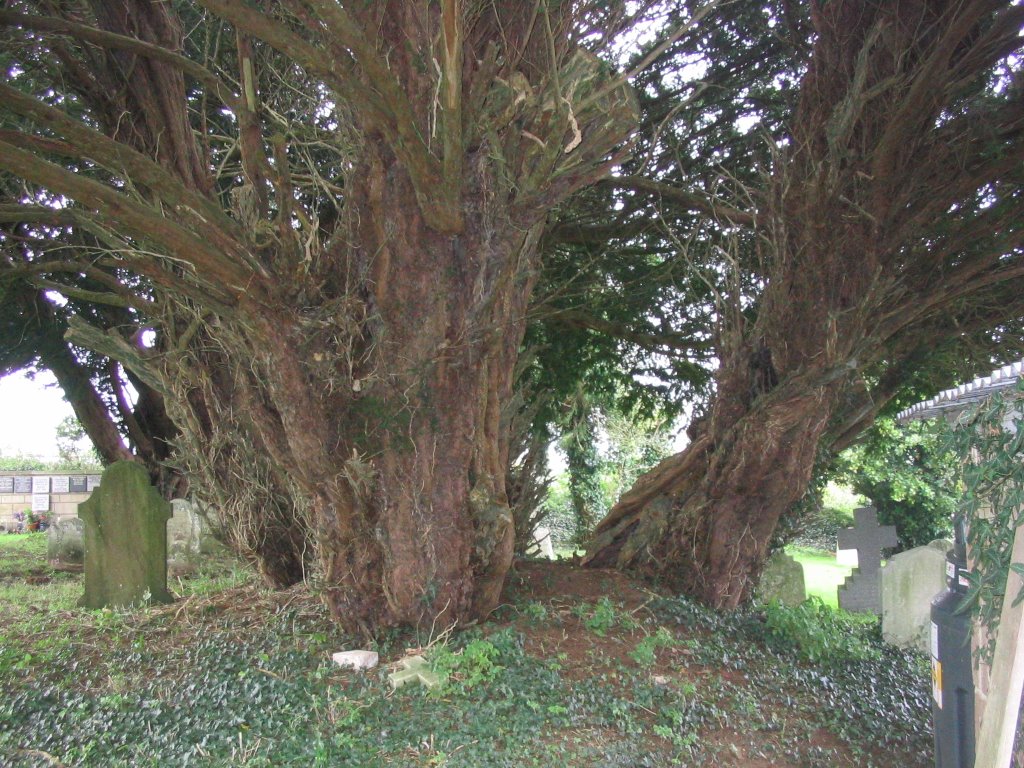
There are many good yew trees in Devon and most of the oldest are found in the churchyards. This tree, though not particularly ancient, is a lovely example and is in Sidmouth to the northwest of the church, hiding in plain sight right by the footpath that runs past the splendid bowling green. These photos are all of this one tree but there are other interesting yews around here, so I will put up some pictures of those in a few days time.
For some reason I don't find a lot of yew trees in my travels and explorations of the woods around here. Some smaller yews can always be found but the large ancient yews do not seem to be in the woods here anymore, or if they are I haven't found them yet. They usually grow as solitary trees but groves of them do still exist, the nearest one that I know of is in Wiltshire and is on a private estate. The yew offers very good shelter and protection from the rain and other elements, making it a useful friend to be around. At the moment the yews are dropping their berries, as can be observed in the photos. Despite what most people think, the flesh of the berries is actually edible and it is rather the seed contained within them that is extremely poisonous. This place is covered with squirrels and their caperings do lighten the sombre mood of the place somewhat.
Here is a short extract from The Sacred Yew by Anand Chetan and Diana Brueton.
Perhaps the most famous yew grove in Britain is Druid's Grove in Surrey. It consists of what appears to be the remains of an ancient avenue of yews, plus many scattered ones, growing in a dense, mixed woodland containing many box trees. The oldest here have long been considered ancient. The novelist George Meredith lived nearby from 1867, and he encouraged his visitors to visit the trees, telling them that 'anyone walking under them should remember that they were saplings when Jesus Christ came to earth'.
Allen Meredith first visited the site in 1981 and has returned several times since to document the trees. He writes:
We came across twisted, shattered fragments, the skeleton remains of ancient yews. In the main avenue we saw enormous yews, some upwards of 24 feet in girth. I found a particularly ancient yew, much of it a mere shell, with rotten decayed wood inside, but as so often with aged yews fresh growth has occurred over many centuries. This relic is still a large tree, over 20 feet in girth. Of the most significant trees, five are over 22 feet in girth and four are over 20 feet. For the trees to have reached this kind of size in such a crowded area must have taken many years. This is one of the few remaining ancient woodlands which has trees that would date back to Roman times.
There is no known historic evidence to tell us how Druid's Grove got its name. Allen believes that some of the trees are over 2,000 years old and the name is no coincidence. The trees seem to form an avenue, which suggests purposeful planting rather than natural distribution. The intended use of the grove is much more open to speculation. Many people have commented on the unusual atmosphere of the place. Some strange things have happened there which, although not dramatic in their own right, when added together suggest that this is a special place. Allen has twice found that he has 'stepped out of time' while in Druid's Grove - that when he has left the grove his watch has shown the same time as when he entered it, despite the watch apparently working perfectly. This also happened to him when he visited Knowlton. On another visit to the grove he came across just one other person, whose name was also Allen Meredith.
The wonder of the world
The beauty and the power,
The shapes of things,
Their colours, lights and shades,
These I saw.
Look ye also while life lasts