Showing posts with label belstone. Show all posts
Thursday, November 26, 2015
The Nine Maidens at Belstone
I was staying in Okehampton for a while recently, doing a bit of cat sitting and catching up on some odd jobs. I had some spare time one morning so I decided to have a potter up the East Okment river, around Ball Hill, to get a bit of fresh air and exercise. The weather was rainy and windy, the sort of stuff I like walking in. As I was enjoying myself, I went further and further up towards Belstone and then got the idea that I would walk up to Belstone and have a look for the stone circle, known as The Nine Maidens, that I'd never managed to see there for some reason. I wasn't very well prepared at all, just having my light training shoes on and a small half empty bottle of water, and my camera of course, which I take nearly everywhere with me. I had no map, but I did have a small compass which is always in my bag.
I had a good old stroll around the hill, which I found to be covered in a lot of bullocks, as they have been reintroduced to many areas now, to keep some of the vegetation down I think.
The trouble with trying to find anything like a stone circle in a place like this is that the whole area is covered with stones of all sizes, so it's almost impossible to find anything out there unless you know exactly where it is, and then it always seems obvious. I walked round the east side of the hill, no luck. I walked up to the first tor and saw no sign of it. I went westwards and found some shelter for a bit, but no sign of it. I had pretty much given up and was heading back, when with the help of my 200mmm lens which doubles as a telescope, I spotted what looked like it in the distance. I was very pleased to find the circle, which actually turns out not to be a circle, but the remains of the outer wall of a burial chamber, or kistvaen, as they're also known as.
The legend behind the Nine Maidens is that a group of maidens danced on a Sunday and were turned to stone. As punishment they must dance every day at noon for the rest of eternity. Curiously, there are lots of legends about stones that were once dancers, and that also move at certain times of the day.
One of the things that is often difficult to get into photographs is the wind. The pictures above appear to be taken on a calm, still day, so I have included this short piece of film of the tree and circle to give a better indication of what the actual conditions were like. Volume warning.
Saturday, July 11, 2015
Belstone
If the flags are flying (as they are here) it means no access to much of the moor, as the army are firing. And sure enough, I could hear firing way off in the distance. You can still walk parts of Dartmoor, but if you try heading for, say, Yes Tor, the road will be blocked by the army. This was just a short evening walk. The Tor in photo one is Watern Tor and the Hurlestone, which is about three miles southeast of where I was standing when I took the photo. The pointy hill with the hut and flag is the aptly named Steeperton Tor, underneath of which is the cleave where the river Taw first becomes a proper river, after gathering itself from the hills to the south of here. Below the hill is the Taw plain.
Sunday, February 13, 2011
Tors at Belstone 2
I have been busy looking up other interesting tors on the internet and have found a real beauty which I am intending to walk to as soon as I am able to find the right combination of time and weather conditions. This particular tor is a long way out and I have not yet decided whether I will be able to walk all the way there and back in one day, so this particular trip might involve a bit of overnight camping.
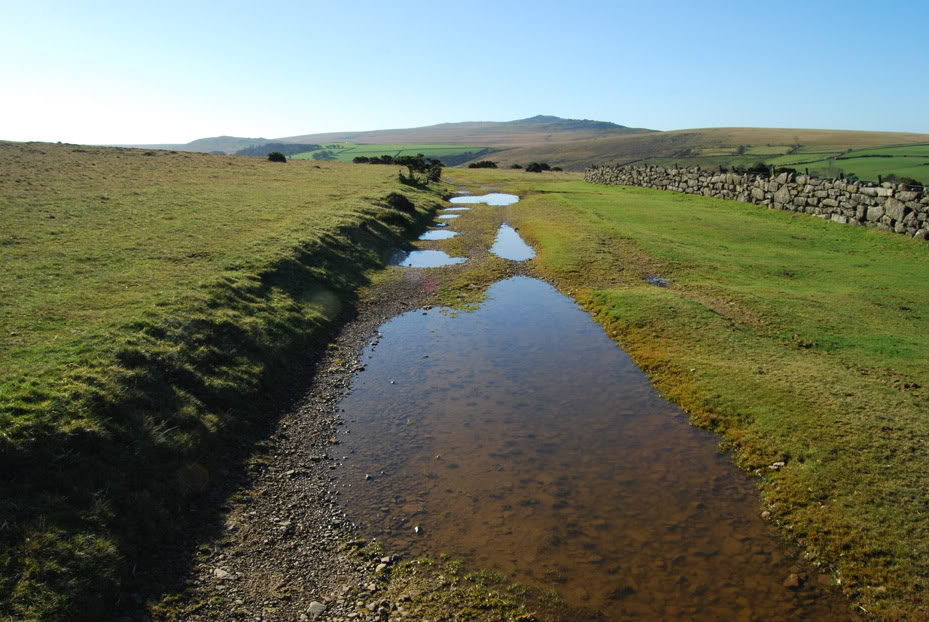
As you can see, Dartmoor is not really the easiest of places to yomp across, as it seems designed to twist the ankle with pretty much every step and it's too far to hop back across all these hills on one leg.
There are such things as mires around here on the lower ground, which should be avoided unless you are very confident about jumping from tussock to tussock. The river cleaves are treacherously rocky and almost every step has to be fully considered. The hilltops, though covered with clitter are ok to walk on, though you get the full force of the weather on top and it is easy to end up walking inside a cloud. All in all none of the distances covered here are that easy and a good stout walking stick is recommended as well as a map and compass. I have walked out here on my own today which is also not really that good an idea, as plenty can go wrong in these short days.
Well that's all for another time and plenty to look forward to. In the meantime we will get back down to Belstone and off to Sticklepath and the bus. The light here is already becoming somewhat lunar, the hills will settle into darkness again soon and this really isn't the place to be out walking at night.
Sunday, January 30, 2011
Tors at Belstone, Dartmoor
It is sunny when I set off on the bus for Sticklepath but the weather can change suddenly on Dartmoor so it is best to take waterproof clothing, whatever the weather looks like. Surprisingly it is still sunny when I get off the second bus and remains so for the whole day. Usually Dartmoor is covered in mists, fogs and rain and generally appears as Devons answer to Mordor, lurking darkly in the distance with its spectacular views hidden, but they won't be today.
First we must walk about half an hour to Belstone, a small village next to the moor and then we will walk around the hill on the north and west side and observe the tors from a distance so as to get the measure of them a bit. Then we shall ascend the hill at Winter Tor and then on up to about 479 Meters (1,572 feet) and back over the top of Belstone Common, stopping to look at some of the tors. That's the plan anyway.
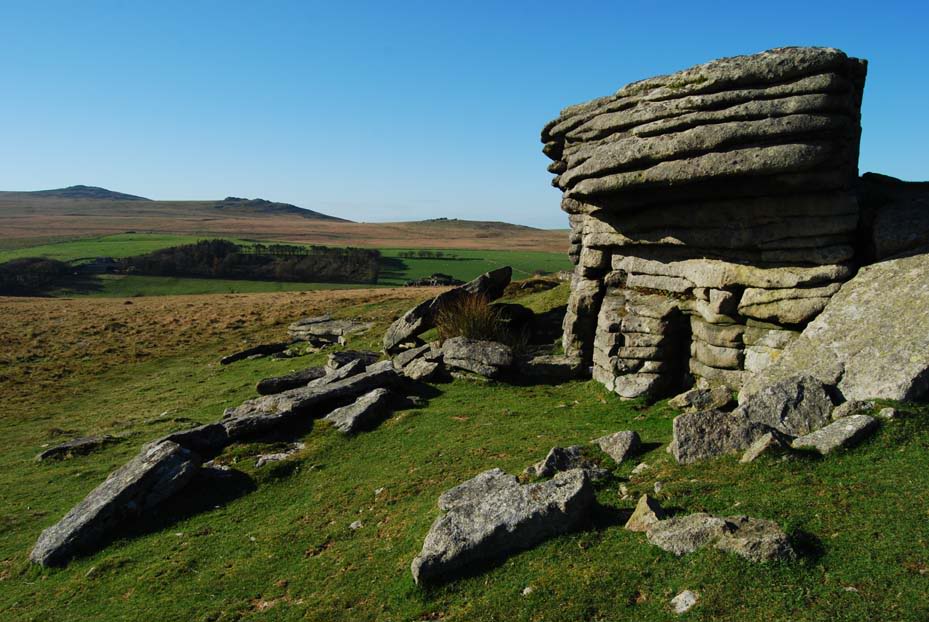
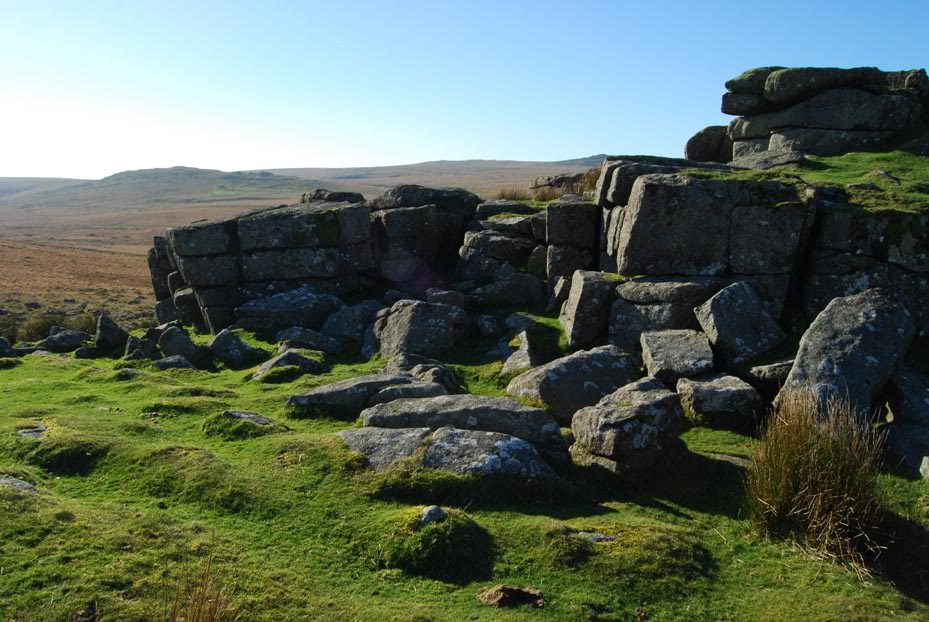
Tor is a Celtic word meaning hill. Dartmoor is a large area of exposed granite, so all the tors are granite and we get a little bit of radon and become a little bit more radioactive for our pleasures. Tors are the result of millions of years of weathering; rain, ice, wind and water all thrown at a nice old prehistoric forest, resulting in this empty and rocky landscape. As the weathering of the tors continues, the rock is broken down into ever smaller sizes and many hillsides are covered with loose rocks, known as clitter, which has been used as a building material here for thousands of years. Eventually the granite is weathered down to a sandy gravel, known as growan, which consists of individual crystals. If you stand here long enough you can hear it happening. At least it feels that way.
Each tor has its own distinct character and presence, some are very castle like whilst others encourage an anthropomorphic response. It is sometimes difficult to believe that the shapes and balances are accidental.
On a day like today and with the right set of eyes you can see as far as the horizon, if not a bit further, and almost all the way back again. The air takes on a chill now and the wind becomes a November taste of colder winds coming. It does feel like you are flying up here, probably something to do with the Psilocybe Semilanceata that's all over the place, (not for me though) and there is the sensation of somehow being in the sky. Well, on we go, the shadows are lengthening and there are plenty more interesting and stranger looking stones to see before we get off the hill.
Tuesday, November 09, 2010
skaigh valley
This morning we set out to walk onto Dartmoor proper, first by traveling to Sticklepath and following the river Taw upstream in the Skaigh Valley, around Belstone Cleave and out past Belstone and onto the moor. This is a very pretty walk this time of year as it is early Autumn and the leaves are just beginning to turn. The path is mostly fine for walking but does become rocky and slippery in places so good walking boots are very much recommended and keep an eye on those rocks underfoot as we don't want to turn an ankle out here.
The river Taw where we are walking is mentioned as a location in Henry Williamsons Tarka the Otter and the river winds its way northwards from here until it meets the coast of Devon 45 miles away. The Taw is in a sunless valley this time of year for most of the first part of the walk and the river courses over many rocks and boulders on its way. As we reach the latter parts of the walk we will come out onto the open wilds of Dartmoor where there will be another very rocky part of river and finally a very quiet smooth stretch on the moor to look forward to. We should also be able to see some Tors on the tops of the hills but we won't have enough time to go up and look at them today so we must save them for another time. There will probably be wild Dartmoor ponies too, which I will not eat my sandwiches in front of so as to not upset them or arouse their curiosity.
The weather as we set off is very fine; still and sunny and bright, though this being Devon and more specifically Dartmoor it can change pretty much instantly into torrential rain or dense fog, so it is good that I am fully equipped with my all terrain mountain hiking slippers, kiss me quick hat, a bit of water, sandwiches and of course plenty of good healthy cigarettes to help invigorate the lungs. Actually it already looks like its going to rain soon and although we are out of the wind down here we won't be when we get out onto the moor. I'm starting to think that waterproof trousers would have been a very good idea and seriously, a compass and a map are a must.
Hopefully next time I might have the space to talk about some of the myths and legends associated with Dartmoor. There are more legends and myths around these parts than sticks can be shaken at, even here with all these sticks we have at hand to shake at things. You go on for a bit and I'll catch you up, I've got a few photos to take and a fag to smoke. See you in a bit.
Labels:
belstone,
dartmoor,
dartmoor pixies,
skaigh valley,
slippers,
sticklepath
Subscribe to:
Posts (Atom)