Showing posts with label tor. Show all posts

Saturday, March 12, 2016

Haytor


A brief visit to Haytor, as we were in the area and I haven't been there for many years. Haytor is one of the most famous and reconisable features on Dartmoor and it bulby protrusion can be seen from many miles away. From the carpark (free and with a handy ice cream van) the walk to Haytor looks easy and gently sloping. This is an illusion, and in the fact the hill rises quite sharply to the summit, although it isn't a long way to walk. I had to stop a few times on the way up to take some photos, look at the view and catch my breath a bit. I was starting to feel that I'd become unfit over the winter, but was cheered up by the huge wheezing sound coming from a party of young french schoolchildren, all being marched up the hill on a geology field trip of some sort, or maybe just a sightseeing trip, but many of whom sounded much more breathless than I felt. Odd really, shouldn't young people be fit rather than wheezy?

Being one the famous and easily accessible tors, Haytor is very busy, and people really do feel the urge to climb right on top of it for some reason, something I never really get the feeling to do, but each to their own. There are certainly some good views from here on a clear day, southeastwards to Teignmouth and the sea, or northwards to various other bits of Dartmoor. I should imagine on a windy and wet day this place might be an altogether different experience.

In 1953, Haytor was used as a major location for the feature film Knights of the Round Table starring Robert Taylor and Ava Gardner. An "elaborate and impressive castle" was built between the two main rock piles of the tor and traditional medieval sports, including jousting, were staged here for the film.

There are quarries in the area and Haytor granite was used in the reconstruction of London Bridge which opened in 1831 and was moved in 1970 to Lake Havasu City in Arizona. The last rock was quarried here in 1919; it was used for the Exeter war memorial.

Saturday, July 11, 2015

Belstone


If the flags are flying (as they are here) it means no access to much of the moor, as the army are firing. And sure enough, I could hear firing way off in the distance. You can still walk parts of Dartmoor, but if you try heading for, say, Yes Tor, the road will be blocked by the army. This was just a short evening walk. The Tor in photo one is Watern Tor and the Hurlestone, which is about three miles southeast of where I was standing when I took the photo. The pointy hill with the hut and flag is the aptly named Steeperton Tor, underneath of which is the cleave where the river Taw first becomes a proper river, after gathering itself from the hills to the south of here. Below the hill is the Taw plain.

Sunday, February 13, 2011

Tors at Belstone 2


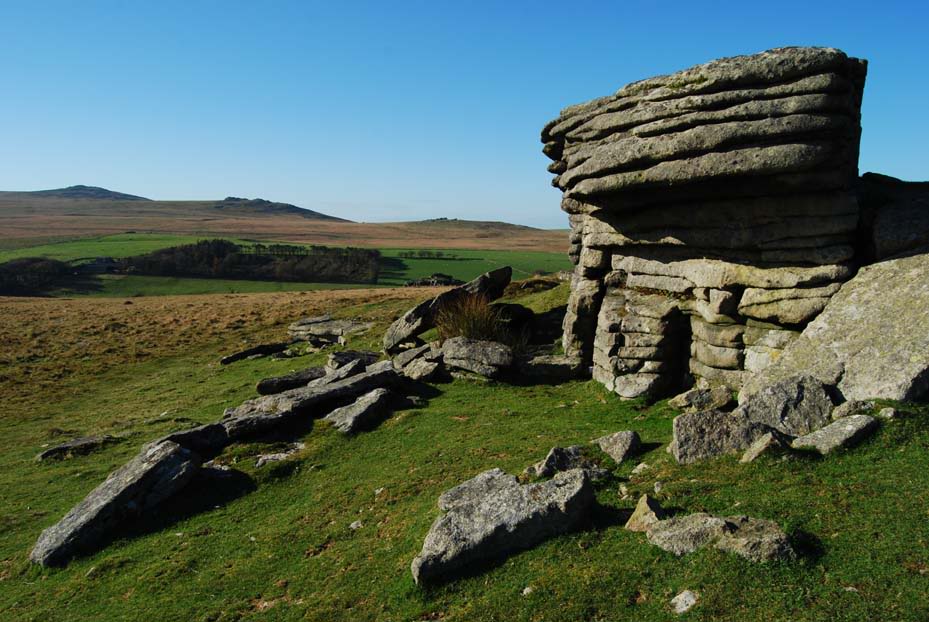
And now we wind our way slowly back across the hill to descend at Belstone, stopping to have a look at some more of the unusual tors on the way.

I have been busy looking up other interesting tors on the internet and have found a real beauty which I am intending to walk to as soon as I am able to find the right combination of time and weather conditions. This particular tor is a long way out and I have not yet decided whether I will be able to walk all the way there and back in one day, so this particular trip might involve a bit of overnight camping.

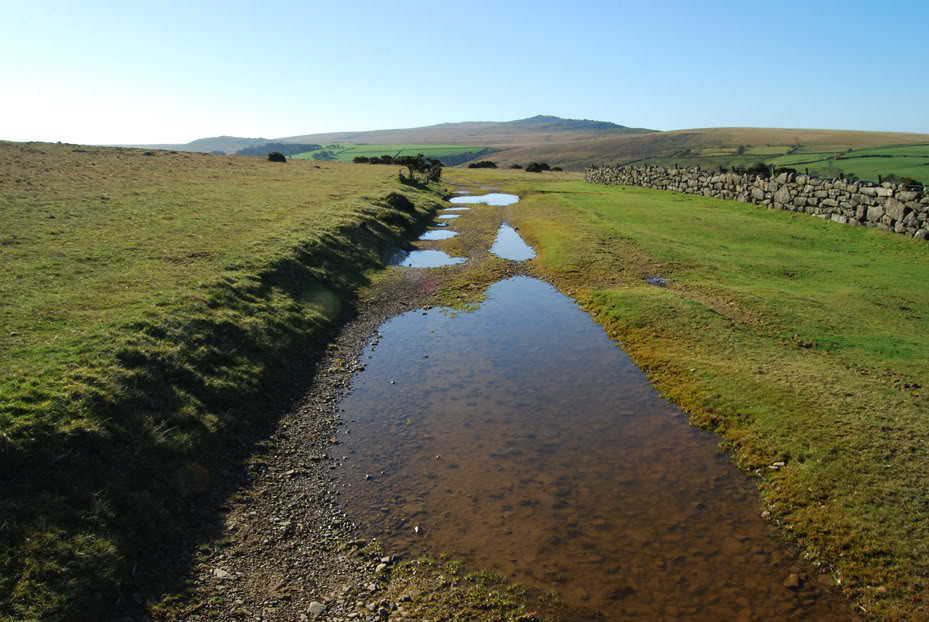
As you can see, Dartmoor is not really the easiest of places to yomp across, as it seems designed to twist the ankle with pretty much every step and it's too far to hop back across all these hills on one leg.

There are such things as mires around here on the lower ground, which should be avoided unless you are very confident about jumping from tussock to tussock. The river cleaves are treacherously rocky and almost every step has to be fully considered. The hilltops, though covered with clitter are ok to walk on, though you get the full force of the weather on top and it is easy to end up walking inside a cloud. All in all none of the distances covered here are that easy and a good stout walking stick is recommended as well as a map and compass. I have walked out here on my own today which is also not really that good an idea, as plenty can go wrong in these short days.

Well that's all for another time and plenty to look forward to. In the meantime we will get back down to Belstone and off to Sticklepath and the bus. The light here is already becoming somewhat lunar, the hills will settle into darkness again soon and this really isn't the place to be out walking at night.

Sunday, January 30, 2011

Tors at Belstone, Dartmoor


It is sunny when I set off on the bus for Sticklepath but the weather can change suddenly on Dartmoor so it is best to take waterproof clothing, whatever the weather looks like. Surprisingly it is still sunny when I get off the second bus and remains so for the whole day. Usually Dartmoor is covered in mists, fogs and rain and generally appears as Devons answer to Mordor, lurking darkly in the distance with its spectacular views hidden, but they won't be today.

First we must walk about half an hour to Belstone, a small village next to the moor and then we will walk around the hill on the north and west side and observe the tors from a distance so as to get the measure of them a bit. Then we shall ascend the hill at Winter Tor and then on up to about 479 Meters (1,572 feet) and back over the top of Belstone Common, stopping to look at some of the tors. That's the plan anyway.

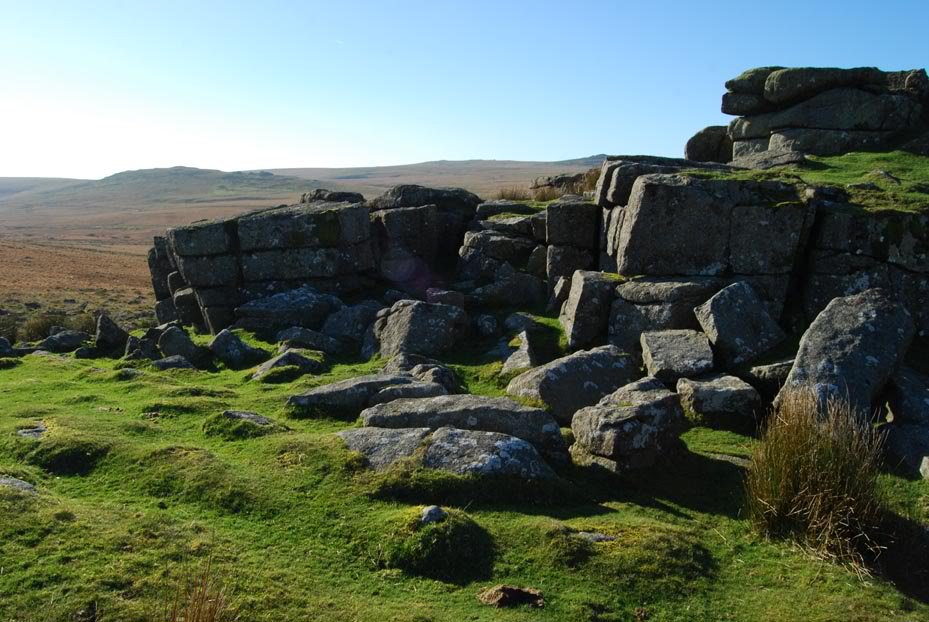
Tor is a Celtic word meaning hill. Dartmoor is a large area of exposed granite, so all the tors are granite and we get a little bit of radon and become a little bit more radioactive for our pleasures. Tors are the result of millions of years of weathering; rain, ice, wind and water all thrown at a nice old prehistoric forest, resulting in this empty and rocky landscape. As the weathering of the tors continues, the rock is broken down into ever smaller sizes and many hillsides are covered with loose rocks, known as clitter, which has been used as a building material here for thousands of years. Eventually the granite is weathered down to a sandy gravel, known as growan, which consists of individual crystals. If you stand here long enough you can hear it happening. At least it feels that way.

Each tor has its own distinct character and presence, some are very castle like whilst others encourage an anthropomorphic response. It is sometimes difficult to believe that the shapes and balances are accidental.

On a day like today and with the right set of eyes you can see as far as the horizon, if not a bit further, and almost all the way back again. The air takes on a chill now and the wind becomes a November taste of colder winds coming. It does feel like you are flying up here, probably something to do with the Psilocybe Semilanceata that's all over the place, (not for me though) and there is the sensation of somehow being in the sky. Well, on we go, the shadows are lengthening and there are plenty more interesting and stranger looking stones to see before we get off the hill.